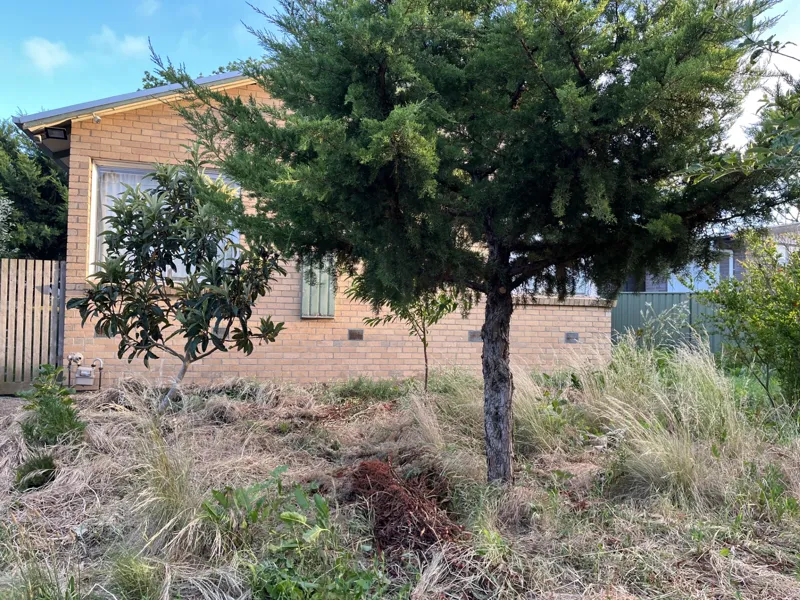
I'm ugly and I'm proud – How does the "World's Ugliest Lawn Contest" break echo chambers and spark a sustainability trend?
There are all kinds of awards in the world—have you ever thought that someone could win one just because their lawn is "ugly enough"?
The seemingly joking and quirky "Ugliest Lawn Contest" was born in 2022 and expanded into the "World's Ugliest Lawn" in 2023. One of the founders, Johan Gustafsson, explained in an interview with the Environmental Information Center (環境資訊中心) that he wanted to challenge the public's traditional aesthetic view of a "perfect lawn," saying, "because it's not natural." He also reached out to Taiwan, inviting everyone to join this special contest.
Leisa Elliott, the winner of the second World's Ugliest Lawn Contest, bought an abandoned garden many years ago. At first, she put a lot of effort into it, but later she gradually realized that nature doesn’t really need her care. Photo credit: Leisa Elliott
Who knows the essence of ugly lawns better than them?
A neatly trimmed, lush green lawn is an important "face" of the yard. But with climate change and increasing pressure on water resources, keeping it green could mean constant watering and high water usage. Gustafsson mentioned, "Lawns have already become one of the largest irrigated crops in the U.S."
"Ugly is the key to this creative initiative and the fastest way to convey the concept." Gustafsson said.
The "World’s Ugliest Lawn Contest" originated on the island of Gotland in Sweden, which has long suffered from drought. Gustafsson had a flash of inspiration: what started as an idea to encourage residents to save water unexpectedly struck a chord with many. Canada and the U.S. even started holding their own ugly lawn contests. Under a Washington Post report, hundreds of comments poured in from people hoping to host a contest in their own cities, which led the organizers to decide to expand the competition globally in 2023.
The "World's Ugliest Lawn Contest" has so far crowned three winners, hailing from Australia and New Zealand. In 2025, past winners were even invited to be judges. Gustafsson joked, after all, "Who knows these ugly, dry lawns better than the past champions, and the benefits they bring to water resources and biodiversity?"
Kathleen Murray, a judge in 2025 and also the winner of the first-ever World's Ugliest Lawn Contest, said, "Our definition of ugly is no human intervention, letting nature take the lead."
Murray, the winner of the first World's Ugliest Lawn Contest, told us that only two percent of Australia's native grasses remain, but only they can survive Australia's dry and harsh environment without needing to be watered. Photo credit: Kathleen Murray.
The winner of the second World's Ugliest Lawn Contest, Elliott, lives in a coastal area of New Zealand, where the soil isn't very nutritious and is mostly rocky. Photo credit: Leisa Elliott
Breaking the yellowing myth
This time, the Environmental Information Center didn't get the chance to fly to Tasmania, Australia to see the unique "charm" of the ugly lawn, but from the video sent by Murray, you can see that her lawn is like a shelter for countless creatures. The round and chubby Tasmanian echidnas are busy eating ants, white-necked stilts are preening their feathers, black-headed honeyeaters take baths in a brown jar, and eastern rosella parrots bring their chicks to drink water.
Murray said that she puts a basin of clean water in the courtyard every day to attract many native birds and mammals. "I love those mischievous Tasmanian brush-tailed possums the most. They sneak to eat the fruit trees at night and often knock over the water basin."
The standards for "ugly" vary a lot, Murray said, and even in rainy areas, a lawn could still win an award. She used this year's winner's lawn as an example—it's yellowing with hints of green, still wild, but not just simply "neglected." "You can tell he didn’t spend a single cent on it," she added.
"I think what's important is 'who can feel happier about the true state of their own lawn.'" Leisa Elliott, the winner of the second World's Ugliest Lawn Contest, pointed out that it’s not about whether the lawn is green, brown, or golden, but about how the lawn owner coexists with nature.
Winning the world's ugliest lawn contest gets you a T-shirt that says "proud owner of The World’s Ugliest Lawn," and this shirt will be passed on to the next winner. Photo credit: Leisa ElliottElliott thinks her lawn is like a piece of art, looking different in every season. Photo credit: Leisa Elliott
"Nature will take care of itself."
Ten years ago, Elliott bought an abandoned garden in Birdlings Flat, New Zealand. Summers were dry and hot, and the sight of everything turning yellow and withered once really frustrated her. Later, she gradually realized that nature takes care of itself, and there was no need for her to worry so much.
"I can't compete with nature, so I choose to go along with it." After winning the competition, Elliott noticed that some people would stop to take photos, and they always smiled knowingly when they heard the story of her award.
"What's it like to win an award for being lazy?" Murray recalled that in 2024, right after she won the first-ever World's Ugliest Lawn Contest, the media asked her this question straight away.
Murray lives in the driest part of Tasmania, Australia, which is currently experiencing a drought. Her lawn looks completely yellow and patchy; The Guardian even described it as looking like the surface of the moon. "Wombats always love digging in my backyard. When the plumber came to work before, he complained for a whole week."
"Now my lawn is like a mini version of a wildlife center or national park, and I don't even have to pay an entrance fee," Murray happily shared. The long grass provides a perfect hiding spot for wildlife, and you can often spot animals like swamp wallabies and blue-tongue lizards.
Murray's lawn often attracts many cute animals, and the blue-tongue lizard is one of them. Photo credit: Kathleen MurrayMurray places a bowl of fresh water in the yard every day, attracting many native birds. The picture shows eastern rosellas drinking water. Photo credit: Kathleen Murray.There are some fruit trees planted near Murray's house, which often attract Tasmanian brushtail possums to visit at night. Photo credit: Kathleen Murray
Murray said that a small animal had dug a hole under the steps of her front door, maybe it was the Tasmanian echidna that hid under the car that day. Photo credit: Kathleen MurrayThe long grass in Murray’s yard provides the best shelter, and wild animals can often be seen there. Pictured is the Tasmanian potoroo. Photo credit: Kathleen Murray.
Starting the "ugly but proud" water-saving trend
Since drought seasons vary around the world, to maximize the impact of the water-saving campaign, submissions for the contest are accepted all year round, and the winners are announced at the beginning of the following year. Winners receive a T-shirt that says "Proud owner of the world's ugliest lawn," which is then passed on to the next winner.
In the dense urban jungle, many people don’t have a lawn, especially in Taiwan. When we asked him about it, Gustafsson admitted that he hadn’t really thought about the issue, but he decided to adjust the competition rules for Taiwan, which could also attract more participants in similar situations.
"As long as you can show a connection to the lawn, submissions are welcome," he said. Of course, you can't just randomly submit a patch of roadside grass; you need to explain your relationship with the lawn, like if it's at your workplace or the lawn of the building where you live.
This "Ugly but Proud" water-saving trend has successfully broken through its usual circle. Besides making it into countless media outlets and textbooks in the Netherlands and the US, Gustafsson noted that even American elementary students have written letters hoping to use the competition as a school research project. Changing water usage habits might not happen overnight, but Gustafsson believes, "Just sparking the discussion is already achieving our goal."
Winning the World's Ugliest Lawn Contest gets you a T-shirt that says "proud owner of the World's Ugliest Lawn," and this shirt will be passed on to the next winner. Photo credit: Leisa Elliott
You can also join the world's ugliest lawn contest
Submission Content
Attach a photo of your ugliest lawn at home, and it's best to write a few sentences in English introducing this lawn and explaining why it's "so ugly." The contest’s original aim is water conservation, but submissions aren't limited by dryness—any naturally growing lawn that doesn't need extra watering or maintenance qualifies.
Can I still participate even if I don't have my own lawn?
Sure, as long as you can explain your connection to this lawn, you're eligible to submit. For example: this is the lawn of my school, or the lawn in front of my office building.
Submission Channel
The World's Ugliest Lawn Contest accepts entries all year round, and submissions for this year's competition are now open.
If you want to participate, you can send your photos in either of the following ways:
❶ Email: Send your entry to the organizer's email ([email protected] / Johan)
❷ Instagram: DM the official account (@worldsugliestlawn) with your submission
Deadline: December 25th every year
When will the award information be announced?
The judging panel meets around Christmas each year to discuss, and the winner is usually announced through the media in early January. The winner gets a second-hand champion T-shirt that says, "proud owner of the World's Ugliest Lawn"
Translated by Joey Adams; Proofread by Vita Liu (劉祐君).