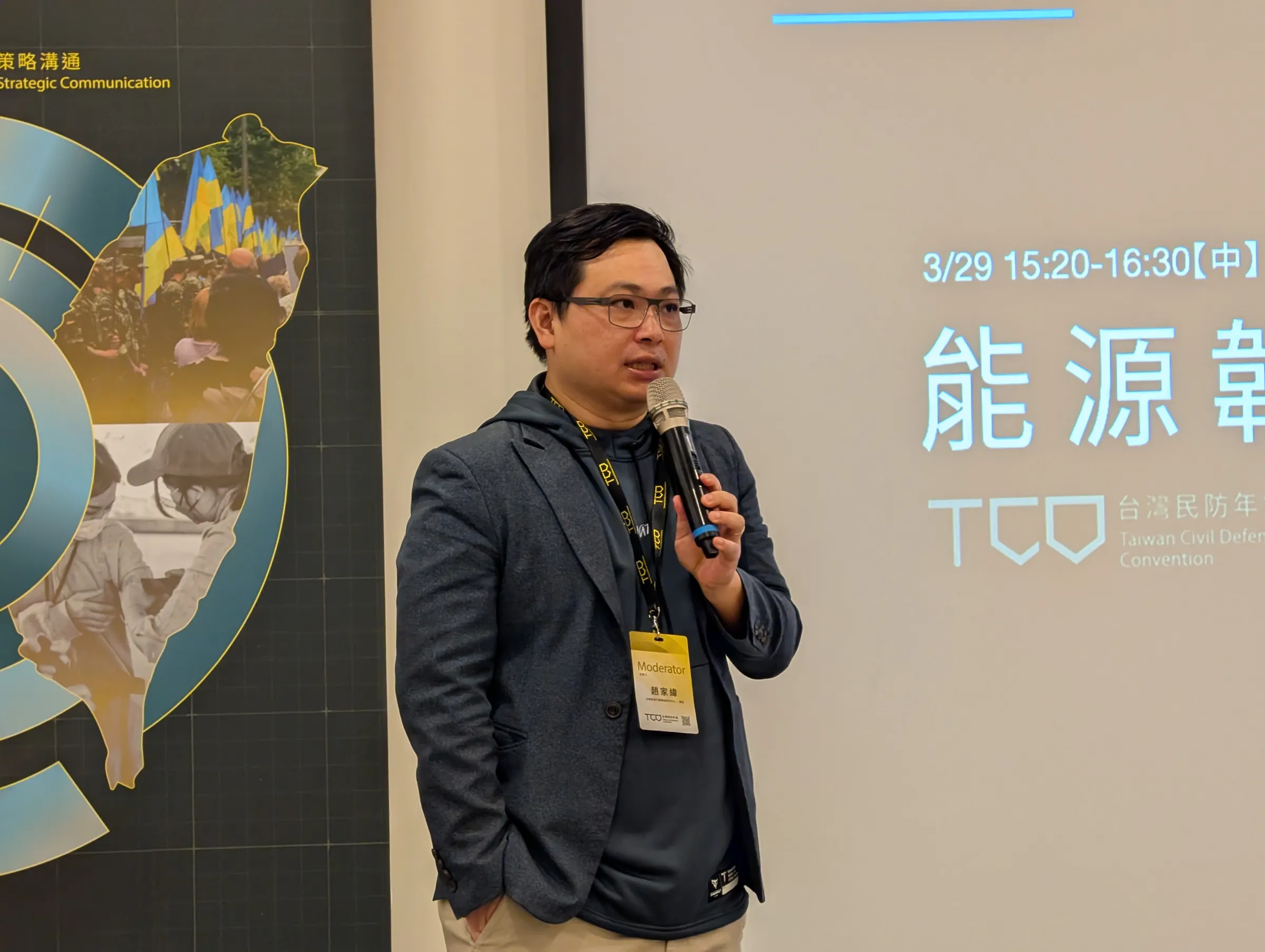
Due to the global energy crisis triggered by the blockade in the Strait of Hormuz, many are thinking about how a possible Chinese invasion of Taiwan could trigger another energy crisis. Foreign media and think tanks generally believe that, in a war blockade, Taiwan's energy reserves would last a maximum of 14 days However, some scholars argue that Taiwan's energy reserves exceed 14 days' worth, and could even last for 200 days. Kuma Academy(黑熊學院) and the Liberal Democratic League of Ukraine (LDLU, 烏克蘭自由民主聯盟) jointly hosted the "2026 Taiwan Civil Defense Convention," with the afternoon session on March 29th focusing on energy resilience.

Can Taiwan’s energy reserves last longer than 14 days?
Taiwan relies on imported fossil fuels for up to 80% of its electricity. Yet if a war between China and Taiwan breaks out, ship owners may be unwilling to transport liquified natural gas (LNG) or coal to Taiwan due to a Chinese military blockade. Foreign think tanks and media believe that under a wartime blockade, Taiwan's energy reserves could only last a maximum of 14 days. However, Lu Tsaiying (呂采穎), director of the Energy Security and Climate Resilience Program at the Research Institute for Democracy, Society, and Emerging Technology (DSET, 科技、民主與社會研究中心), believes that effectively coordinating renewable energy sources with natural gas and coal is sufficient to cover up to 80% of electricity demand. "Taiwan's electrical tenacity is absolutely not just 14 days."
Lu Tsaiying argues that Taiwan should establish formal ship dispatch and coordination mechanisms with friendly countries such as Japan and South Korea. Furthermore, a publicly available shipping information platform and comprehensive shipping insurance would allow shipping operators to clearly understand the Taiwan Strait’s true risks.
Chao Chia-Wei(趙家緯), director of the Taiwan Climate Action Network (TCAN, 台灣氣候行動網絡), estimates that if Taiwan achieves its 2027 energy targets, its domestic electricity and natural gas reserves could generate approximately 90 billion kilowatt-hours of electricity, accounting for 30% of its current total power generation.
Chao Chia-Wei mentioned, in extreme scenarios such as blockades or war, overall electricity demand will decrease. It is just like the situation on the second day of the Lunar New Year, the whole country is on holiday. Most factories are not open, but stores like 7-Eleven are still open. At this time, the main electricity consumption is household electricity.
After stopping non-critical industrial energy use, electricity consumption will be further reduced by about 30%-40%. In this scenario, Taiwan's energy supply can last for more than 200 days (about 6 months).
The green energy lesson from Ukraine
Chao Chia-Wei emphasised that Iran’s blockade of the Strait of Hormuz has triggered the world's largest energy crisis in history, on the similar scale to COVID-19 pandemic. Currently, domestic solutions for Taiwan’s energy resilience focus on restarting nuclear power plants and sourcing Alaskan LNG. But looking at Ukraine can offer an alternative example of energy resilience during wartime, as the country's infrastructure actually relies heavily on solar power and energy storage systems.
Lu Tsaiying shared that since the Russia-Ukraine War started in 2022, Ukraine has added 3GW of renewable energy, an amount equivalent to the annual electricity consumption of 1.2-1.5 million households in Taiwan. Many Ukrainian households continue to install solar panels and energy storage devices, as well as prepare small diesel and natural gas generators. In addition, plug-in solar panels and wood-burning stoves also support the necessary power supply and heating facilities in hospitals, schools, and shelters.
Shortly after the war, the Ukrainian government launched the "Affordable Loans 5-7-9%," providing businesses with low-interest or interest-free loans to install solar panels and uninterruptible power supply (UPS) systems. She pointed out that local factories not only have UPS systems and generators to "protect themselves," but proactively adjust their electricity demand in a timely manner, protecting the national power grid via demand response (DR, 需量反應).
Now, how do high-tech factories in Taiwan continue to operate under wartime conditions? In a post-conference interview, Lu Tsaiying stated that Taiwan's wafer factories possess very high-level uninterruptible power systems (UPS) and diesel generators. When an emergency power outage occurs, diesel generators can quickly be deployed to support operations. However, diesel generators cannot operate indefinitely as they require maintenance and repair approximately every three days.
She believes that in the face of war risks, industries need to set up alternative energy sources such as solar panels and energy storage. However, most high-tech industries only purchase Renewable Energy certificates and rarely build their own solar systems. Large-scale energy storage requires a large area, if factories or science parks haven't reserved enough space, it is difficult to build.
Engaging Local Communities by Not Talking About Energy
Huang Pinhan (黃品涵), secretary-general of the Mom Loves Taiwan Association (媽媽氣候行動聯盟), analyzed that enemy forces may not directly attack large power plants during wartime, but may choose to destroy power transmission and distribution networks such as substations, transmission towers, and utility poles. This would cause electricity to be unable to reach people's homes smoothly.
She believes that strengthening decentralized microgrids is essential to ensure that locally generated electricity can be used through independent energy storage systems in communities and households, especially when the national power grid's transmission and distribution lines are damaged. "Today, when running out of fuel, as long as there is sunlight, our power plant will generate electricity, and it can also store it with an energy storage system."
However, she also admitted that energy storage equipment is expensive. A single 13 kWh Tesla Powerwall battery, which has safety certification, costs NT$300,000 to NT$350,000. Although some local governments offer subsidies for home batteries, the quotas are limited. For example, Taoyuan City has only subsidized 13 cases, "It's like trying to grab concert tickets—you just can't get them."
Huang Pinhan shared that Yuanli Township in Miaoli County, which has made progress in promoting microgrids, the team actually avoided "talking about energy" in the beginning, but emphasized the necessity of disaster prevention to the public. This made many residents willing to evaluate the construction of photovoltaic-storage microgrids, and many village chiefs were even "motivated" to try to promote it, even without receiving official subsidies. As a result, the Yuanli Township Office proactively allocated a budget of NT$100,000 to encourage the community to start related work.
Besides military attacks, Taiwan may also face cyberattacks by hackers targeting Taipower's critical nodes (such as substations). However, Lu Tsaiying observed that because Taipower's Operations Technology and IT systems are separated, "in the past, only the official website has been attacked; the internal network scheduling and other critical control equipment have not been attacked."
Translated by Jaye Brayboy; Proofread by Stella Cammack.


